


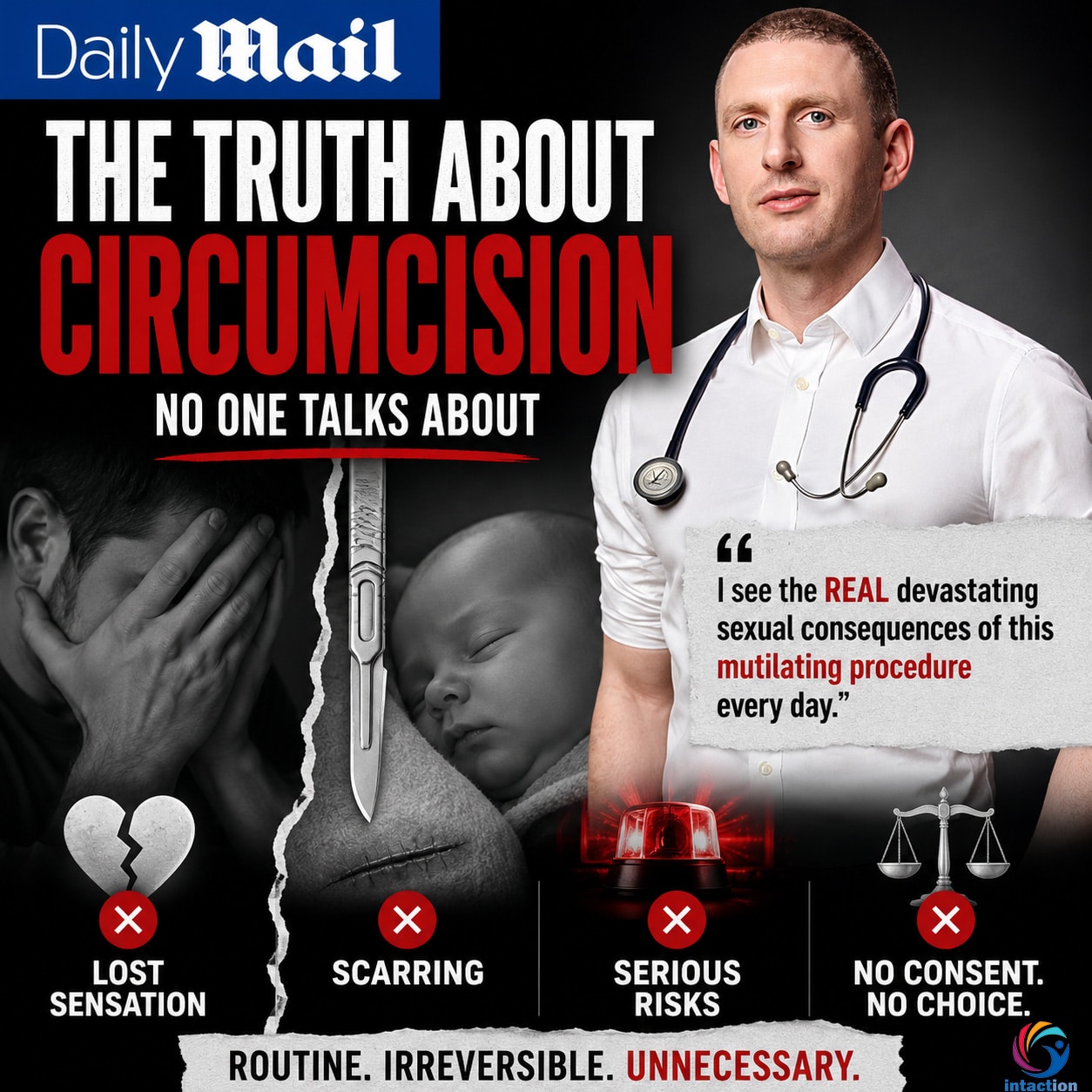
I’m a doctor and am circumcised myself. But I see the REAL devastating sexual consequences of this
mutilating procedure every day. Here’s what no one tells you…
When I was at medical school, a close friend took me aside one evening and told me something
I’ve never forgotten. He could feel nothing during sex.
Here was an articulate young man in his 20s, close to tears, telling me that something most men
never think twice about had been taken from him before he could even speak. Because he’d been
circumcised as a baby.
Around the time he confided in me, he’d just got his first girlfriend and found himself suddenly
confronted with the problem, with no idea what to do about it. He wasn’t expecting me to fix it.
I think he simply needed one other person to know, and he trusted me.
I’ve thought about him a lot this past week, after reading the report in Good Health on men living
with exactly this kind of damage. And to judge from the response from readers, circumcision is a
subject many of you have strong views on.
An estimated 15 per cent of British men have had the procedure, many as children, and some of the
stories are grim: painful erections, lost sensation, scarring, infections. And relationships that fell apart
over a problem the men involved could barely put into words, and never agreed to in the first place.
After years of helping men who carry some of these consequences, let me say the thing nobody quite
wants to: routine, non-medical circumcision is male genital mutilation. There. I’ve said it.
I’m circumcised myself. It was done when I was five, for medical reasons, because I had phimosis,
where the foreskin won’t pull back properly and which left me with repeated infections and pain.
A GP recommended it, my parents agreed, and I was operated on by a paediatric urologist.
It’s never given me a moment’s trouble since, physically or emotionally. So this isn’t some wounded
man settling old scores.
It’s the view of a doctor who’s seen, time and again, what non-medical circumcision can do.
Over the years, I’ve had patients confide that circumcision has caused them sexual problems. In one
case, it had done such anatomical damage that penetration was impossible altogether.
The decision to circumcise a baby is not some benign act, highlighted by the particularly awful story of
Mohamed Abdisamad. At six months old he was circumcised by someone with no medical qualifications.
Within days he was unwell and had to be rushed to hospital, where he had a cardiac arrest – a post-mortem identified the cause as a Streptococcus infection picked up during the procedure.
Last December, the assistant coroner for west London felt compelled to issue a Prevention of Future
Deaths report, warning that without a change in the law, more babies would die the same way.
It wasn’t the first such tragedy.
Back in 2012, a nurse named Grace Ebun Adeleye was convicted of manslaughter for circumcising a four-week-old boy with scissors and olive oil and no anaesthetic in a home procedure. He bled to death.
There have been 14 recorded deaths in England between 2001 and 2024 with circumcision listed on the
death certificate. Half were children. The Office for National Statistics admits the true total is almost
certainly higher, since the procedure doesn’t always make it on to the paperwork.
The shocking fact most people simply don’t know is that in this country, anyone can circumcise a child.
You need no medical training of any kind. Nobody licenses you, nobody inspects you, and there’s no
requirement to keep records or bother with infection control. We regulate tattoo parlours more tightly
than we regulate the cutting of healthy tissue from a boy’s penis.
I’m circumcised… Here is what no one tells you about the devastating effect on your sex life
We’ve been through something like this before, with female circumcision. For years it went on quietly
inside certain communities and barely anyone made a fuss.
Then campaigners did something subtly brilliant: they changed the words. Female circumcision
became female genital mutilation (FGM), and almost overnight people saw it for what it had always been:
a barbaric practice sheltering behind a tidy, medical-sounding name.
We banned it. And rightly so.
So why can’t we bring ourselves to say the same about boys?
The procedure strips healthy, working, nerve-rich tissue from a child who can’t possibly consent. The sex of that child has no bearing on the ethics.
Object to one and you have to object to the other. Yet there is a grotesque, unjust double standard that
still exists here.
Look at what happened only this year. In January, the Crown Prosecution Service drafted new guidance
that, for the first time, named non-therapeutic circumcision as something that ‘may be a form of child abuse or an offence against the
person’ if carried out in unsafe or inappropriate conditions.
But following outcry from religious groups, within weeks the CPS had backed off, stripping out the
‘child abuse’ wording and shifting circumcision out of the section on harmful practices altogether.
Dr Niall McCrae, a mental health expert at King’s College London, has argued for years that male
circumcision sits on a par with FGM in terms of harm, and that we are simply too frightened to say
so for fear of treading on religious toes. He’s right.
You might say a child can’t consent to any operation, so why single this one out? But that
misunderstands what consent is standing in for. We operate on children who can’t agree to it all the
time, on a burst appendix, a hole in the heart, a cleft palate, because something is wrong and the
surgery puts it right.
My own case was exactly that: I had a condition, it caused me pain and infection, and an operation fixed it.
Non-medical circumcision is the precise opposite. Nothing is wrong with the child. We take a knife to
working tissue not to treat anything, but to satisfy a tradition.
One is medicine. The other is culture borrowing the tools of medicine. I can already hear the pushback.
For plenty of men, circumcision really is a non-issue. Like me, they have happy, healthy sex lives and never give it a second thought. Plenty of men
would tell you they manage perfectly well without a foreskin.
But that argument leaves me cold. Imagine a society that whipped off the little toe of every newborn,
not for any medical reason but simply as a matter of routine, or tradition.
Then there’s the hygiene argument: the notion is that the penis is somehow dirty by design, something
to be improved with a scalpel. Suggest the same about female anatomy, propose taking a blade to little
girls to keep them cleaner, and the country would erupt, quite correctly.
Now, it’s true that urine and other matter can get trapped under the foreskin, and in a small number of
men that may cause chronic inflammation, and occasionally a condition called lichen sclerosus which,
in a few cases, is linked to penile cancer.
But penile cancer is rare; it affects around 800 men a year in this country. And the answer to i
nflammation is gloriously dull: retract the foreskin, wash underneath, dry it properly, done. It’s basic
hygiene. You do not amputate healthy tissue from a baby to ward off a rare disease he can easily avoid
with soap and water. After all, a woman’s genitals have folds that need washing too. Yet nobody would
dream of taking a knife to a baby girl to save her the bother.
We teach hygiene, we screen, and we treat problems if and when they actually arise.
The one proven medical benefit of circumcision is a small fall in HIV transmission. But the answer to
that is to teach our sons about safe sex, not to lop pieces off them just in case.
So what about the men already living with the fallout?
The psychological toll is heavier than most imagine. Many of these men carry what look unmistakably
like the hallmarks of trauma: intrusive thoughts, and a deep sense of violation. A great many stay silent,
fearing they’ll be told to ‘man up’, or that raising it betrays their family or their faith.
One man I saw – who’d been left with a physical deformity and reduced sensation that had affected his sex life – was incandescent with rage at what he felt his parents had sanctioned being done to him, without his
consent, on religious grounds. Deeply depressed, he was finally helped with psychotherapy.
Psychosexual therapy can also help a man – and, where there is one, his partner – rebuild intimacy through structured exercises and honest conversation, taking the pressure and the
shame out of sex.
The College of Sexual and Relationship Therapists keeps a register of accredited practitioners.
For the physical side – dryness or friction during sex – a decent lubricant is often the simplest fix that’s often overlooked. Some men find non-surgical foreskin restoration (gradually stretching the remaining skin), brings back some sensitivity
over time.
Revision surgery, grafting skin from the thigh or abdomen, is available privately but is costly.
And don’t neglect the emotional side. Grief, anger, a sense of having been violated are all entirely
reasonable responses to something done to you without your say-so. Talking therapy can help here (ask your GP for referral).
But the answer, of course, is to stop doing this to children.
We need to call this out for what it is. Not circumcision. Not tradition. Not a snip. Male genital mutilation.
Phimosis never necessitates circumcision. Never. Not one tight foreskin can’t be solved via less invasive means. I was circumcised at 14 for Phimosis. It destroyed all sexual pleasure and gave me ED. It is not a medical procedure, it’s a religious blood sacrifice. It’s also far worse than any FGM in terms of functionality/sensory loss. All the erogenous nerves are in the foreskin which has been proven via histological analysis.
I found your reply very interesting, every word is correct.
What happens after circumcision procedure carried out, leaves someone completely and totally grounded?
A five year old shouldn’t be capable of developing pathological phimosis because the foreskin is meant to be naturally fused to the glans at that age, similarly to a fingernail. The foreskin should naturally separate over the course of puberty.
If a five year old experiences symptoms of pathological rather than physiological phimosis, it is almost certainly because a doctor or parent forcibly retracted their foreskin, which should never be done. Forcibly retracting a fused foreskin can result in scar tissue that causes long term complications, and is a comparably abusive practice to forcibly breaking a child’s hymen. As a result of widespread ignorance of normal genital anatomy, many doctors and parents aren’t aware of this and engage in forcible retraction that later becomes an excuse to mutilate when the consequences emerge.
Even in cases of legitimate adulthood phimosis, “circumcision” should pretty much never be an acceptable solution. Phimosis that doesn’t resolve with daily stretching can be treated surgically with a dorsal slit that loosens the skin without removing functional erogenous tissue. Since we live in a world where genital mutilation is normalized, we’ve developed a medical culture in which a radical amputation is seen as an acceptable approach to treat medical issues that are resolvable with minimally invasive treatments that don’t needlessly impair function.